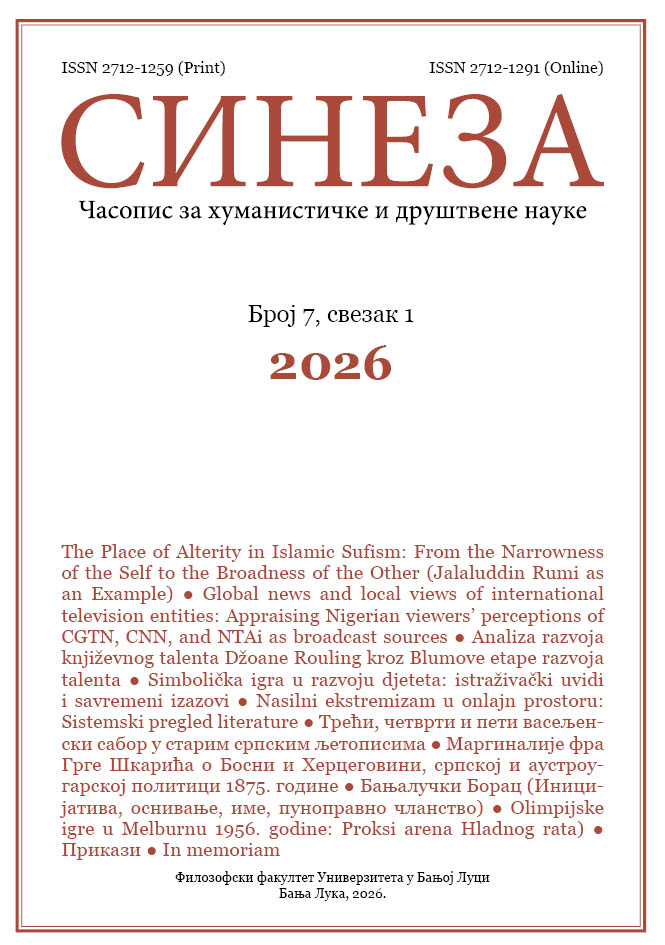
Symbolic Play in Child Development: Research Insights and Contemporary Challenges
DOI:
https://doi.org/10.63356/sin.2026.004Keywords:
symbolic play, holistic development, mental representation, imaginationAbstract
Play is one of the most natural and essential human activities, present from the earliest stages of childhood, and it provides the foundation for intellectual, emotional, social, and physical development. Imagination, deep engagement in fictional scenarios, flexibility, the use of symbols, and role-taking are distinctive features of symbolic play. This form of activity is primarily driven by intrinsic motivation, that is, by engagement that does not rely mainly on external rewards or reinforcements. During childhood, it serves as an irreplaceable medium for development, as it aligns with the principles of psychophysical growth.
The aim of this paper is to examine symbolic play within the framework of child development and the contemporary context, through both theoretical and empirical perspectives. A review of the available literature highlights the holistic significance of symbolic play. It contributes to the formation of social skills, supports cognitive, physical, and linguistic development, and fosters creativity and imagination. In addition, symbolic play is considered in light of contemporary challenges and the role of intentionality.
The analysis of relevant research studies underscores the significance of symbolic play in peer relationships, prosocial behaviors, and, more broadly, in the development of social competence, creativity, language acquisition, and emotional understanding in children. Longitudinal studies particularly emphasize that symbolic play continues to be an important aspect of life in later stages, with substantial developmental effects. The conclusions presented in this paper provide a foundation for pedagogical implications that can be applied in contemporary educational and family practices, focusing on raising awareness among adults and strengthening their capacity to recognize and support the importance of symbolic play.
References
Antonijević, R. (2014). Utemeljenje sistema znanja u pedagogiji. Filozofski fakultet, Institut za pedagogiju i andragogiju.
Badurina, P. (2015). Odgojitelj i simbolička igra, Napredak, 156(1-2), 47–75.
Barber, S. E., Kelly, B., Collings, P. J., Nagy, L., Bywater, T., & Wright, J. (2017). Prevalence, trajectories, and determinants of television viewing time in an ethnically diverse sample of young children from the UK. The International Journal of Behavioral Nutrition and Physical Activity, 14(1), 88. https://doi.org/10.1186/s12966-017-0541-8
Bodrova, E. (2008.). Make-believe play versus academic skills: a Vygotskian approach to today’s dilemma of early childhood education. European Early Childhood Education Research Journal, 16(3), 357–369.
Brković, A. (2011). Razvojna psihologija. Regionalni centar za profesionalni razvoj zaposlenih u obrazovanju.
Bruner, J. (2000). Kultura obrazovanja. Educa.
Casper, V., & Theilheimer, R. (2010). Early childhood education: Learning together. McGraw-Hill Companies.
Creaghe, N., Quinn, S., & Kidd, E. (2021). Symbolic play provides a fertile context for language development. Infancy, 26(6), 980–1010. https://doi.org/10.1111/infa.12422
Creaghe, N., & Kidd, E. (2022). Symbolic play as a zone of proximal development: An analysis of informational exchange. Social Development, 31(4), 1138–1156. https://doi.org/10.1111/sode.12592
Deunk, M., Berenst, J., & De Glopper, K. (2008.). The development of early sociodramatic play. Discourse Studies, 10(5), 615–633.
Djačenko, О. М., & Lavrantjeva, Т. V. (1998). Psihički razvoj predškolske djece. Zavod za udžbenike i nastavna sredstva.
Duran, M. (2003). Dijete i igra. Naklada Slap.
Fiorelli, J. A., & Russ, S. W. (2012). Pretend play, coping and subjective well-being in children. American Journal of Play, 5(1), 81–103.
Fung, W. K., & Cheng, R. W. Y. (2017). Effect of school pretend play on preschoolers’ social competence in peer interactions: Gender as a potential moderator. Early Childhood Education Journal, 45(1), 35–42. https://doi.org/10.1007/s10643-015-0760-z
Goldstein, T. R., & Lerner, M. D. (2018). Dramatic pretend play games uniquely improve emotional control in young children. Developmental science, 21(4), e12603. https://doi.org/10.1111/desc.12603
Hill, D., Ameenuddin, N., Reid Chassiakos, Y. L., Cross, C., Hutchinson, J., Levine, A., & Swanson, W. S. (2016). Media and young minds. Pediatrics, 138(5), e20162591. https://doi.org/10.1542/peds.2016-2591
Howes, C., & Matheson, C. C. (1992). Sequences in the development of competent play with peers: Social and social pretend play. Developmental Psychology, 28(5), 961–974. https://doi.org/10.1037/0012-1649.28.5.961
Ilić, M. (2013). Porodična pedagogija. Filozofski fakultet.
Ilić, M. (2013). Pedagoške implikacije Pijažeove teorije intelektualnog razvoja za nastavu i učenje. Inovacije u nastavi, 26(4), 100–113.
Ivon, H. (2013). Lutka i lutkarska igra u kurikulumu predškolskog odgoja. Školski vjesnik, 62(1), 43–54.
Jaggy, A. K., Mainhard, T., Sticca, F., & Perren, S. (2020a). The emergence of dyadic pretend play quality during peer play: The role of child competence, play partner competence and dyadic constellation. Social Development, 29(4), 1–19. https://doi.org/10.1111/sode.12445
Jaggy, A. K., Perren, S., & Sticca, F. (2020b). Assessing preschool children’s social pretend play competence: An empirical comparison of three different assessment methods. Early Education and Development, 31(8), 1206–1223. https://doi.org/10.1080/10409289.2020.1712633
Kamenov, E. (2006). Dečja igra – Vaspitanje i obrazovanje kroz igru. Zavod za udžbenike
Kamenov, E. (2002). Predškolska pedagogija. Zavod za udžbenike i nastavna sredstva.
Kolčaković, М., & Lasić, К. (2022). The role of play in preschool children. Módszertani Közlöny, 12(1), 10–23. https://doi.org/10.18485/uns_modszer.2022.12.1
Kovačević, Z., & Gluvak, J. (2023). Čega se deca igraju, čime i gde – sagledavanje igre iz dečje perspektive. Research in Pedagogy, 13(1), 19–35.
Kowalski, H. S., Wyver, S. R., Masselos, G., & De Lacey, P. (2004). Toddlers’ emerging symbolic play: a first-born advantage?. Early Child Development and Care, 174(4), 389–400. https://psycnet.apa.org/doi/10.1080/0300443032000153435
Krasnor, L. R., & Pepler, J. D. (1980). The study of children’s play: Some suggested future directions. New Directions for Child and Adolescent Development, 9, 85–95. https://doi.org/10.1002/cd.23219800908
Krnjaja, Ž. (2012). Igra kao susret – koautorski prostor u zajedničkoj igri dece i odraslih. Etnoantropološki problemi, 7(1), 251–267.
Lillard, A. S., Lerner, M. D., Hopkins, E. J., Dore, R. A., Smith, E. D., & Palmquist, C. M. (2013). The impact of pretend play on children’s development: A review of the evidence. Psychological Bulletin, 139(1), 1–34. https://doi.org/10.1111/cdev.12227
Lillard, A. S. (1993.). Pretend play skills and the child’s theory of mind. Child development, 64, 348–371.
Mahmutović, A. (2013), Značaj igre u socijalizaciji djece predškolskog uzrasta, Metodički obzori, 18(2), 21–33 https://doi.org/10.32728/mo.08.2.2013.02
Maljković, M. (2005). Metodički priručnik za razvoj govora dece predškolskog uzrasta. Savez pedagoških društava Vojvodine.
Marjanovic Umek, LJ., Lesnik Musek, P., Pecjak, S., & Kranjc, S. (1999). Symbolic play as a way of development and learning of preschool children in preschool institutions, European Early Childhood Education Research Journal, 7(1), 35–44.
McAloney, K., & Stagnitti, K. (2009). Pretend play and social play: The concurrent validity of the childinitiated pretend play assessment. International Journal of Play Therapy, 18(2), 99–113. https://doi.org/10.1037/a0014559
Miljak, A. (2009). Življenje djece u vrtiću. Novi pristupi u shvaćanju, istraživanju i organiziranju odgojno-obrazovnog procesa u dječjim vrtićima. SM Naklada.
Mullineaux, Y. P., & Dilalla, L. (2009). Preschool pretend play behaviors and early adolescent creativity. The Journal of Creative Behavior, 43(1), 41-57.
Muppalla, S. K., Vuppalapati, S., Reddy Pulliahgaru, A., & Sreenivasulu, H. (2023). Effects of excessive screen time on child development: An updated review and strategies for management. Cureus, 15(6), e40608. https://doi.org/10.7759/cureus.40608
Nwokah, E., & Graves, K. N. (2009). Word Play: The creation and function of novel word in the pretend play of two siblings. American Journal of Play, 1(4),429–450.
Orr, E., & Geva, R. (2015). Symbolic play and language development. Infant Behavior and Development, 38, 147–161. https://doi.org/10.1016/j.infbeh.2015.01.002
Partalo, S. (2014). Kreativnost i konformnost u simboličkoj igri predškolske djece. Inovacije u nastavi, 27(1), 65-73.
Pehar, L. (2008). Predškolska pedagogija. FPMOZ
Perren, S., Sticca, F., Weiss-Hanselmann, B., & Burkhardt Bossi, C. (2019). Let us play together! Can play tutoring stimulate children’s social pretend play level?. Journal of Early Childhood Research, 17(3), 205–219. https://doi.org/10.1177/1476718X19849248
Petrović-Sočo, B. (2014). Symbolic play of children at an early age. Croatian Journal of Education, 16(1), 235–251.
Popović, I., & Radujkov, M. (2014). Značaj igre u vaspitanju predškolskog deteta. U M. Joković (Ed.), Zbornik radova sa međunarodnim učešćem „Vaspitač u 21. veku“ (pp. 173–182). Visoka škola za vaspitače strukovnih studija.
Reber, A., & Reber, E. (2010). Rečnik psihologije. Službeni glasnik.
Richard, S., Baud‐Bovy, G., Clerc‐Georgy, A., & Gentaz, E. (2021). The effects of a ‘pretend play‐based training’ designed to promote the development of emotion comprehension, emotion regulation, and prosocial behaviour in 5‐to 6‐year‐old Swiss children. British Journal of Psychology, 112(3), 690–719. https://doi.org/10.1111/bjop.12484
Russ, W. S., Robins, A. L., & Beth A. C. (1999). Pretend play: longitudinal prediction of creativity and affect in fantasy in children. Creativity Research Journal, 12(2), 129–139.
Sidera, F., Lillard, A., Amadó, A., Caparrós, B., Rostan, C., & Serrat, E. (2021). Pretending emotions in the early years: The role of language and symbolic play. Infancy, 26(6), 920–931. http://dx.doi.org/10.1111/infa.12414
Slunjski, E. (2001.). Integrirani predškolski kurikulum: rad djece na projektima. Mali profesor.
Smits-van der Nat, M., Wilt, F., & Martijn, M., Veen, C. (2024). The value of pretend play for social competence in early childhood: a meta-analysis. Educational Psychology Review, 36(46), 1–26. https://doi.org/10.1007/s10648-024-09884-z
Stakić, M. (2016). Igre mašte u funkciji razvoja govora dece predškolskog uzrasta. In E. Kopas-Vukašinović & B. Stojanović (Eds.), Nacionalni naučni skup sa međunarodnim učešćem, 25. mart 2016., Jagodina, „Savremeno predškolsko vaspitanje i obrazovanje: Izazovi i dileme” (pp. 129–140). Fakultet pedagoških nauka Univerziteta u Kragujevcu.
Stanisavljević-Petrović, Z., & Anđelković, S. (2018). Igra kao vodeća aktivnost i razvoj dečije kreativnosti. In D. Stolić (Ed.), Zbornik radova sa međunarodnim učešćem „Vaspitač u 21. veku“ (pp. 408–413). Visoka škola za vaspitače strukovnih studija.
Stankov, Lj., & Jovanović, M. (2018). Uloga vaspitača u posticanju kreativnosti dece predškolskog uzrasta. In D. Stolić (Ed.), Zbornik radova sa međunarodnim učešćem „Vaspitač u 21. veku“ (pp. 316–321). Visoka škola za vaspitače strukovnih studija.
Stojanović, B. (2012). Igra i igrolike aktivnosti u nastavi početnog čitanja i pisanja. Godišnjak Srpske akademije obrazovanja, 8, 203–218.
Suzić, N. (2006). Uvod u predškolsku pedagogiju i metodiku. XBS.
Šefer, J. (2013). Symbolic play and analogy: a way to foster children’s creativity. Creativity and Early Cognitive Development, 2, 63–66. https://cdn.aaai.org/ocs/5796/5796-24500-1-PB.pdf
Tahirović, S. (2016). Moć igre u podsticanju psihološkog razvoja djece i mladih. Zbornik radova islamskog pedagoškog fakulteta, 14, 199–220.
Thompson, B. N., & Goldstein, T. R. (2019). Disentangling pretend play measurement: Defining the essential elements and developmental progression of pretense. Developmental Review, 52, 24–41. https://doi.org/10.1016/j.dr.2019.100867
Thyssen, S. (2003). Child culture, play and child development. Early Child Development and care. 173(6), 589–612 . https://doi.org/10.1080/0300443032000070509
Vinikot, D. V. (1999). Igranje i stvarnost. Zavod za udžbenike i nastavna sredstva.
Zlatanović, Lj. (2018). Funkcije i tipovi igre u ranom detinjstvu: holistička perspektiva. U D. Stolić (Ed.), Zbornik radova sa međunarodnim učešćem „Vaspitač u 21. veku“ (pp. 301–309). Visoka škola za vaspitače strukovnih studija.
Zotović-Kostić, M. (2023). Pijažeova teorija kognitivnog razvoja: osnovni koncepti i kritike. Filozofski fakultet.
Živanović, S., Perućica, R., Kaurin, S., Vuković, B., Kalajdžić, O., & Ćalasan, S. (2023). Problem (ne)intencionalnosti u pedagogiji – pogled iz ugla pedagoga. DHS, 2(23), 557–578. https://doi.org/10.51558/2490-3647.2023.8.2.557
World Health Organization [WHO]. (2019). Guidelines on physical activity, sedentary behaviour and sleep for children under 5 years of age. World Health Organization. https://iris.who.int/handle/10665/311664
Wynberg, E. R., Boland, A., Raijmakers, M. E., & van der Veen, C. (2022). Towards a comprehensive view of object-oriented play. Educational Psychology Review, 34(1), 197–228. https://doi.org/10.1007/s10648-021-09608-7